A traditional fire alarm system is designed to alert building occupants that an emergency is occurring. But an alarm tone alone doesn’t tell people what to do next.
In an emergency, clear instructions can make a critical difference. A voice evacuation fire alarm system allows building owners and facility managers to provide occupants with specific instructions, such as evacuating, relocating to another area, or following emergency procedures.
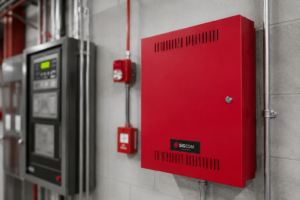
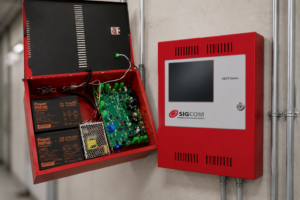
The good news is that adding voice evacuation doesn’t necessarily mean replacing an existing fire alarm control panel. The SigCom VECP Series is designed to integrate with existing fire alarm control panels, making it possible to upgrade an existing system with voice evacuation capability.
Here are five reasons to consider adding voice evacuation to an existing fire alarm system.
- Provide Clearer Emergency Instructions
A traditional notification appliance can alert occupants to a fire, but a voice message can provide specific instructions about what they should do.
Instead of simply hearing an alarm tone, occupants can receive a prerecorded or live voice announcement telling them to evacuate, relocate, or follow other emergency procedures.
This can be especially valuable in larger or more complex facilities where occupants may not immediately know where to go or how to respond.
The SigCom VECP Series supports prerecorded voice messages as well as live voice communication through a supervised microphone. The newer VECP-60, for example, includes five user-programmable voice messages and seven alert tones.
The result: emergency communication becomes more informative than an alarm signal alone.
- Upgrade Your Existing Fire Alarm System Without Replacing the FACP
One of the biggest advantages of a voice evacuation upgrade is that you may not need to start over with a completely new fire alarm system.
The VECP Series is specifically designed to work as an adjunct to an existing fire alarm control panel. It can connect to a listed FACP and receive activation through a 24 VDC polarity-reversing NAC circuit or supervised dry contact input.
That means facilities can add voice evacuation capability while continuing to use their existing fire alarm infrastructure.
For building owners, this can mean:
- Less disruption to an existing system
- No need to replace a functioning FACP solely to add voice
- A more straightforward upgrade path
- The ability to expand emergency communication capabilities as facility needs change
Adding voice doesn’t always mean replacing what you already have.
- Improve Communication in Large or Complex Facilities
The larger and more complicated a facility is, the more important clear emergency communication becomes.
Schools, healthcare facilities, office buildings, places of assembly, military facilities, factories, and other large buildings may have multiple floors, wings, rooms, or designated areas where occupants need to receive emergency instructions. SigCom identifies these types of facilities among typical applications for its VECP Series.
A voice evacuation system can distribute emergency messages through strategically located speakers, helping instructions reach occupants throughout the building.
And when additional coverage or audio power is needed, the system can be expanded.
For example, SigCom’s DAPB-100 Distributed Audio Power Booster adds up to 100 watts of audio power and four additional supervised speaker circuits. Multiple boosters can also be used when additional capacity is required.
This makes voice evacuation useful not only for an initial upgrade, but also as a facility grows or its communication requirements change.
- Make Future Expansion Easier
A fire alarm system that meets today’s needs may not meet tomorrows.
Buildings can be renovated, expanded, reconfigured, or repurposed. Additional floors, rooms, classrooms, offices, or occupied areas may create a need for additional speaker coverage and audio capacity.
A scalable voice evacuation system makes it easier to accommodate these changes.
The DAPB-100, for example, can be installed near the primary voice panel or remotely where additional audio power is needed. It provides four additional Class A or Class B supervised speaker circuits and can be combined with additional boosters for applications requiring more power.
This gives installers and facility professionals more flexibility when expanding the existing voice evacuation installation.
Think of voice evacuation as an upgrade that can grow with the building, not a one-time investment that limits future options.
- Add More Functionality to Your Life Safety System
Voice evacuation can transform a fire alarm system from a system that primarily alerts occupants into one that can also communicate with them.
Depending on the system configuration, voice evacuation can provide:
- Prerecorded emergency messages
- Field-selectable alert tones
- Live voice paging
- Multiple speaker circuits
- Supervised audio circuits
- Expandable audio power
- Integration with an existing fire alarm control panel
The SigCom VECP-60 combines a 60-watt Class D digital amplifier, built-in supervised microphone, battery backup and charging system, programmable messages, and multiple activation options in a single panel.
For facilities looking to improve emergency communication without completely replacing their existing fire alarm infrastructure, this provides a practical path toward a more capable life safety system.
When Should You Consider Adding Voice Evacuation?
An existing fire alarm system may be a good candidate for a voice evacuation upgrade when:
- The facility is undergoing a fire alarm system upgrade
- A building renovation is adding or changing occupied spaces
- Additional emergency communication capabilities are needed
- The facility has multiple floors or large occupied areas
- Clearer emergency instructions are desired
- Additional speaker coverage or audio power is required
- The existing FACP is still suitable, but voice capability needs to be added
Before making changes to a life safety system, the installation should be designed and evaluated according to the applicable codes, listing requirements, and requirements of the authority having jurisdiction.
Add Voice Evacuation Without Starting Over
Adding voice evacuation to an existing fire alarm system doesn’t necessarily require replacing the entire system. The SigCom VECP Series is designed to integrate with existing FACPs and provide a practical way to add emergency voice communication.
Whether you’re upgrading a school, healthcare facility, office building, industrial facility, military installation, or other occupied space, voice evacuation can provide a more informative and flexible approach to emergency notification.
Ready to add voice evacuation to an existing fire alarm system?
Explore SigCom’s Voice Evacuation Systems to learn more about the VECP Series, DAPB-100, and available system configurations.
Explore SigCom Voice Evacuation Systems